Bristol Rural Branch
Part of The Gloucester & Bristol Diocesan Association of Church Bell Ringers
Introduction to Bell Ringing
New to bell ringing?
At first sight church bell ringing (bellringers don’t usually call bell ringing campanology!) may appear difficult and complicated. We hope that this short introduction will satisfy your curiosity and allay any fears.
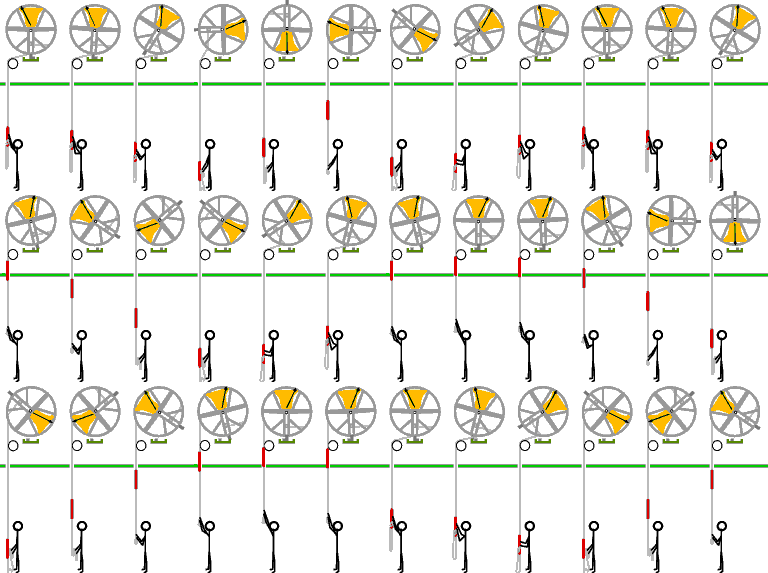
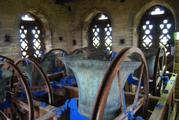
Church bells are located high in the tower in the room above where the bellringers stand to ring. The bells swing through a full circle, beginning and ending their swing with their mouth facing upwards. Each rope winds on and off a wheel about one and a half metres in diameter, and the bellringer must learn to use the rope to vary the swing of the bell, forcing the bell to sound quicker or slower. Each time the bell swings it will sound its note just once. The bells can swing only slowly, due to their size, so it’s not possible to play ‘tunes’ by this method.
Each bellringer controls one bell, and even the smallest bell (the one with the highest note) is a lot heavier than the bellringer. The heaviest bell is called the ‘tenor’ and can weigh more than a small car!
Church bells are located high in the tower in the room above where the bellringers stand to ring. The bells swing through a full circle, beginning and ending their swing with their mouth facing upwards. Each rope winds on and off a wheel about one and a half metres in diameter, and the bellringer must learn to use the rope to vary the swing of the bell, forcing the bell to sound quicker or slower. Each time the bell swings it will sound its note just once. The bells can swing only slowly, due to their size, so it’s not possible to play ‘tunes’ by this method.
Each bellringer controls one bell, and even the smallest bell (the one with the highest note) is a lot heavier than the bellringer. The heaviest bell is called the ‘tenor’ and can weigh more than a small car!
Why we ring church bells
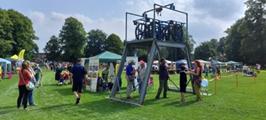
One reason the bells are rung is to call worshippers to Church. But in addition for a bellringer, the pleasure of ringing the intricate pattern described by the method, with each bell fitting neatly among its fellows.
It might take about five to ten lessons to learn to handle a bell – rather like learning to ride a bicycle. The next stage is learning the bell-control needed to fit your bell in with the other ringing bells, and this usually takes about two or three months of weekly practice sessions. During this stage a bellringer will learn to ring ‘call-changes’, as mentioned earlier.
Finally there are the ‘methods’ and the mysteries of ‘rope-sight’. Watch any bellringer’s eyes as they rings – you will see the eyes dart left and right as they check their own position. They are watching the other ropes to find the correct place among for their own. For each ‘change’ the bellringer must move their bell to a new place in the order. This stage of learning lasts a lifetime!
It might take about five to ten lessons to learn to handle a bell – rather like learning to ride a bicycle. The next stage is learning the bell-control needed to fit your bell in with the other ringing bells, and this usually takes about two or three months of weekly practice sessions. During this stage a bellringer will learn to ring ‘call-changes’, as mentioned earlier.
Finally there are the ‘methods’ and the mysteries of ‘rope-sight’. Watch any bellringer’s eyes as they rings – you will see the eyes dart left and right as they check their own position. They are watching the other ropes to find the correct place among for their own. For each ‘change’ the bellringer must move their bell to a new place in the order. This stage of learning lasts a lifetime!
Ringing changes and methods

Rather than playing tunes, bellringers ring 'methods', which consist of a long sequence of ‘changes’. The bells are first ‘raised’ into their mouth-up position – quite a laborious business that you may see at the start of a ringing session. Then, after a short rest, the ringers will start off in ‘rounds’, which is when the bells sound in a simple descending scale, one after the other in sequence.
The bellringers will be aiming for evenly spaced notes, with just a slight pause after every bell has sounded twice. For example, with six bells you will hear six notes, another six notes, and a short a pause.
After a few descending scales are rung in this way, the real ringing will start. This may be ‘call-changes’, in which one of the ringers, the conductor, will call for selected bells to change places in the order of sounding. Or on the instruction of the conductor, the ringers begin to change the order of sounding according to a pre-arranged pattern called a ‘method’.
These ‘methods’ have to be memorised, at first simple ones, then more and more complex. In any method the order of bells is constantly changing, and is usually not repeated until all the possible orders have been rung.
With four bells there are 4 x 3 x 2 x 1 = 24 different orders (or ‘permutations’, if you’re more comfortable with a mathematical definition) before a sequence has to be repeated (sequences like 1234, 2143, 2413, 4231, etc.). With six bells there are 720 orders, with eight bells there are 40,320 different orders, and to ring them all takes about 28 hours (and it has been done!). Churches with ten or even twelve bells are not uncommon. We'll leave you to calculate the number of permutations ;-)
Each order is called a ‘change’ – which is why we talk of “ringing the changes”. 5000 (or more) changes is referred to as a ‘peal’, which takes about three hours to ring. Commemorative peal-boards on the ringing room walls record notable peals.
The bellringers will be aiming for evenly spaced notes, with just a slight pause after every bell has sounded twice. For example, with six bells you will hear six notes, another six notes, and a short a pause.
After a few descending scales are rung in this way, the real ringing will start. This may be ‘call-changes’, in which one of the ringers, the conductor, will call for selected bells to change places in the order of sounding. Or on the instruction of the conductor, the ringers begin to change the order of sounding according to a pre-arranged pattern called a ‘method’.
These ‘methods’ have to be memorised, at first simple ones, then more and more complex. In any method the order of bells is constantly changing, and is usually not repeated until all the possible orders have been rung.
With four bells there are 4 x 3 x 2 x 1 = 24 different orders (or ‘permutations’, if you’re more comfortable with a mathematical definition) before a sequence has to be repeated (sequences like 1234, 2143, 2413, 4231, etc.). With six bells there are 720 orders, with eight bells there are 40,320 different orders, and to ring them all takes about 28 hours (and it has been done!). Churches with ten or even twelve bells are not uncommon. We'll leave you to calculate the number of permutations ;-)
Each order is called a ‘change’ – which is why we talk of “ringing the changes”. 5000 (or more) changes is referred to as a ‘peal’, which takes about three hours to ring. Commemorative peal-boards on the ringing room walls record notable peals.
A bellringer's world
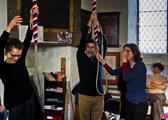
Bellringers don’t always ring the same bell, nor do they ring at just one tower. There is a constant mingling of bands and ringers across the Branch and beyond. In the summer we go on day-outings to ring the bells at pre-arranged towers around the country, usually about six towers in a day with a pub-lunch at midday. It is a wonderful way to explore the countryside and its churches, and to try one’s hand with unfamiliar bells.
Ringing church bells is a rather English thing, invented more than 400 years ago. There are roughly 6,291 towers in the world where bells swing full-circle and methods can be rung. Of these, most are in England (5,868). Wales has 186, Ireland has 41, Scotland has 24, Guernsey has 8 and Jersey has 2. Beyond the British Isles, Australia has 71 towers, America has 71, Central Europe has 5 and Asia has 2. Towers are to be found in many countries with present or past ties with England. Numbers are constantly changing as redundant bells are restored to full ringing potential, but sadly bells occasionally also fall into disrepair and become unsafe to ring.
Ringing church bells is a rather English thing, invented more than 400 years ago. There are roughly 6,291 towers in the world where bells swing full-circle and methods can be rung. Of these, most are in England (5,868). Wales has 186, Ireland has 41, Scotland has 24, Guernsey has 8 and Jersey has 2. Beyond the British Isles, Australia has 71 towers, America has 71, Central Europe has 5 and Asia has 2. Towers are to be found in many countries with present or past ties with England. Numbers are constantly changing as redundant bells are restored to full ringing potential, but sadly bells occasionally also fall into disrepair and become unsafe to ring.
Anyone can be a bellringer
Perhaps you would like to try bell ringing? It’s not strenuous, but it is good exercise, both physical and mental. Once you can ring call-changes, you can turn up at almost any church and cathedral from Sydney Australia to Washington DC and be invited to ring with the local band.
And you don't need to be famous or even musical to enjoy ringing church bells 😉 Pink Floyd rocker swaps Division Bell for church bell
And you don't need to be famous or even musical to enjoy ringing church bells 😉 Pink Floyd rocker swaps Division Bell for church bell
Visit your local tower
If you would like to learn more about bell ringing, please
contact
us, or you can pop along to one of the towers listed on this website and speak to the Tower Contact or one of the local bellringers.